Poet Roy G. Guzmán, author of Catrachos (Graywolf Press, 2020), on RAM (Damaged Goods Press, 2018):
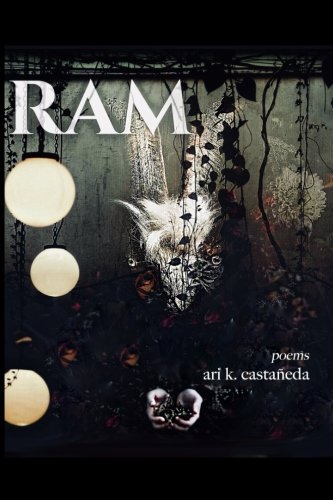
“With the Aeneid, Virgil intended to alchemize a distinctly Latin myth by magnifying a minor character from Homer’s Greek poem, the Iliad. In a way, translation begins from a need to (re)create one’s own identity or origin story.
Ari K. Castañeda understands too well that translation isn’t simply what we etymologically understand as a reposition of materials through time and space; instead, what RAM reveals is that series of transformations that occur, at least linguistically, when people are silenced, displaced, disembodied, and subcategorized. The character of Ram is distilment but also recuperation. RAM is about the history of violence in our canon, about men furnishing patriarchal myths at the cost of misjudging the lives that stand in their way. But like the saga of a word like queer, Ram fights back. ‘but ram doesn’t wanna,’ we’re told. ‘ram eats things to see what’s inside them … ram pushes herself up from horse corpse w bloodied hooves.’ This is decadent poetry. This is powerfully articulated feminist poetry. When Ram says, ‘finally, all my pain walks w joy,‘ I think of Plath, Sarah Kane, Audre Lorde. I believe Ram. I believe Ram.”
- Additional Publications can be found in:
- Bone Bouquet
- g*MOB
- Yes, Poetry
- plus Crab Fat, Leopardskin & Limes, Georgetown Review, and more.
More Praise for RAM from Jordi Alonso, author of the Sappho-inspired collection Honeyvoiced (XOXOX Press, 2014):
“Ari K. Castañeda’s RAM is an otherworldly book. A ‘feminist erasure of Vergil’s Aeneid,’ it harnesses the liminalities inherent in the media of translation and erasure poetry to create something that is not entirely a translation, nor yet entirely an erasure. As an erasure of a translation of the Aeneid, it straddles many already tenuous boundaries, such as gender, originality, and a familiar story, to create beauty. We are quickly introduced to a new character, Ram, who uses the found text, Frederick Ahl’s Aeneid translation, to sing, not of arms and man, but ‘of seahorse’ and ‘a land home to rams.’ This breaks open the familiar story and uses its pieces to create something new.
A handful of the poems in the collection show us Castañeda’s thought-process, these poems, all untitled, consist of a line or lines of Latin, treated as material for an erasure poem, and then its translation. By perusing this series of poems in the collection, we might, as bilingual readers, wonder how a language with case markers whose word order is quite free, can be translated, erasured, or both, into one where not case, but word order makes meaning; yet, Castañeda’s sure hand ensures that we don’t need to know Latin in order to enjoy, appreciate, and marvel at the craft of RAM.”

